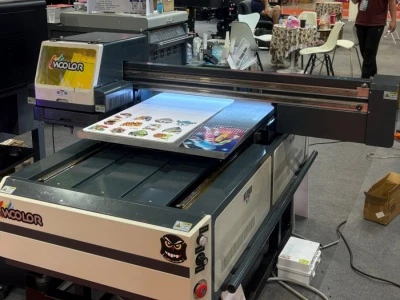
The core principle of a desktop UV printer is "inkjet printing combined with instant UV curing." The print head precisely deposits UV-curable ink onto the surface of the material, which is then immediately exposed to UV light, causing the ink to transition from a liquid state to a solid film in an extremely short amount of time.
By jetting UV ink onto the substrate and subsequently curing it instantly via a UV-LED light source, the process achieves rapid drying. This technology eliminates the need for the evaporation-based drying process required by traditional solvent-based inks, significantly enhancing production efficiency (often reducing a single print cycle to just a few minutes).
Inkjetting: Driven by electrical signals, a piezoelectric printhead ejects UV-curable ink onto the material's surface in the form of micron-sized droplets.
UV Curing: A UV lamp (typically an LED cold light source) positioned next to the printhead emits ultraviolet light. Photoinitiators within the ink absorb this energy to generate active free radicals, which trigger a polymerization reaction that causes the ink to cure instantly.
Imaging: By precisely controlling the movement of the printhead and the placement of each ink droplet, a complete image is constructed line by line.